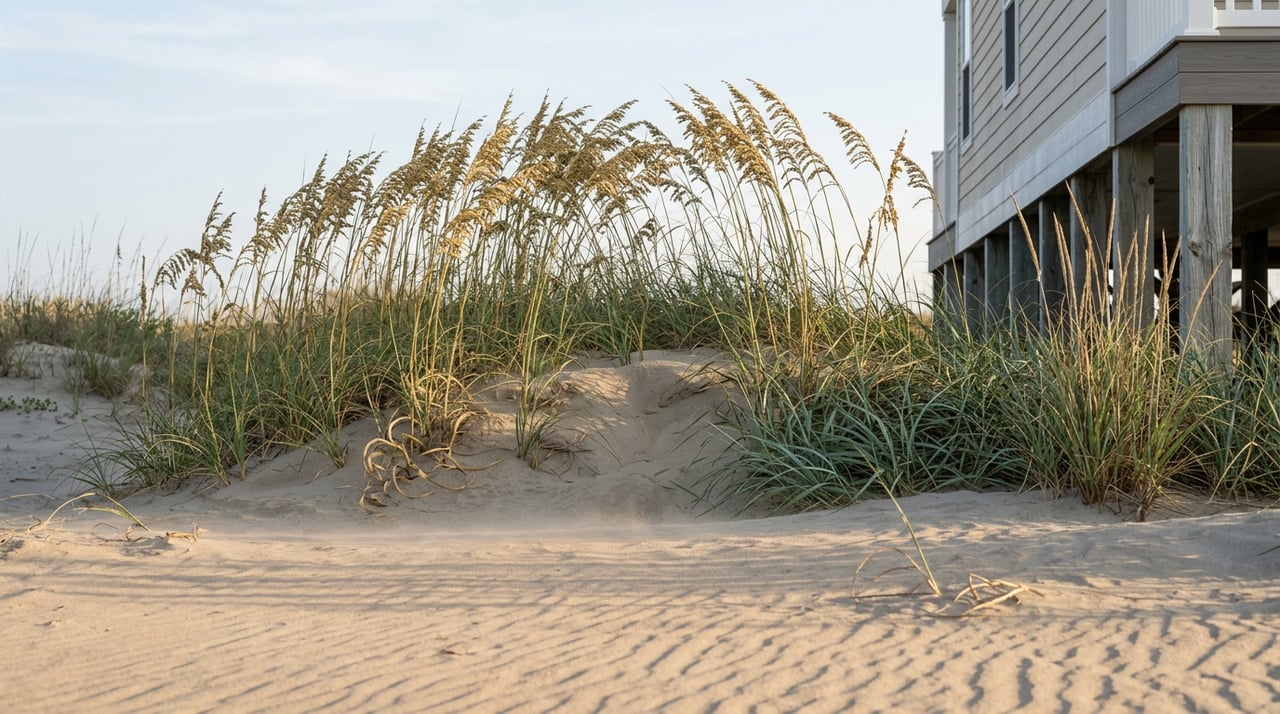
Why Caswell Beach Harvests Its Own Dunes Every September
September 17, 2026
September 17, 2026
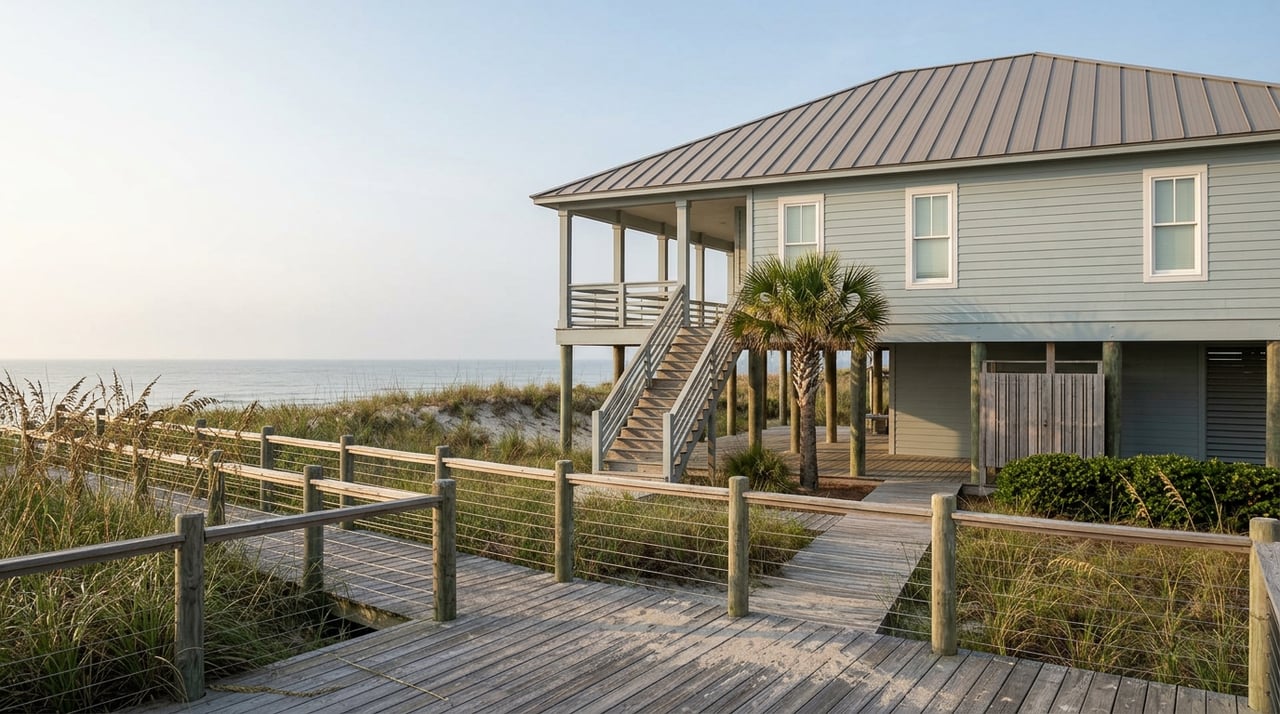
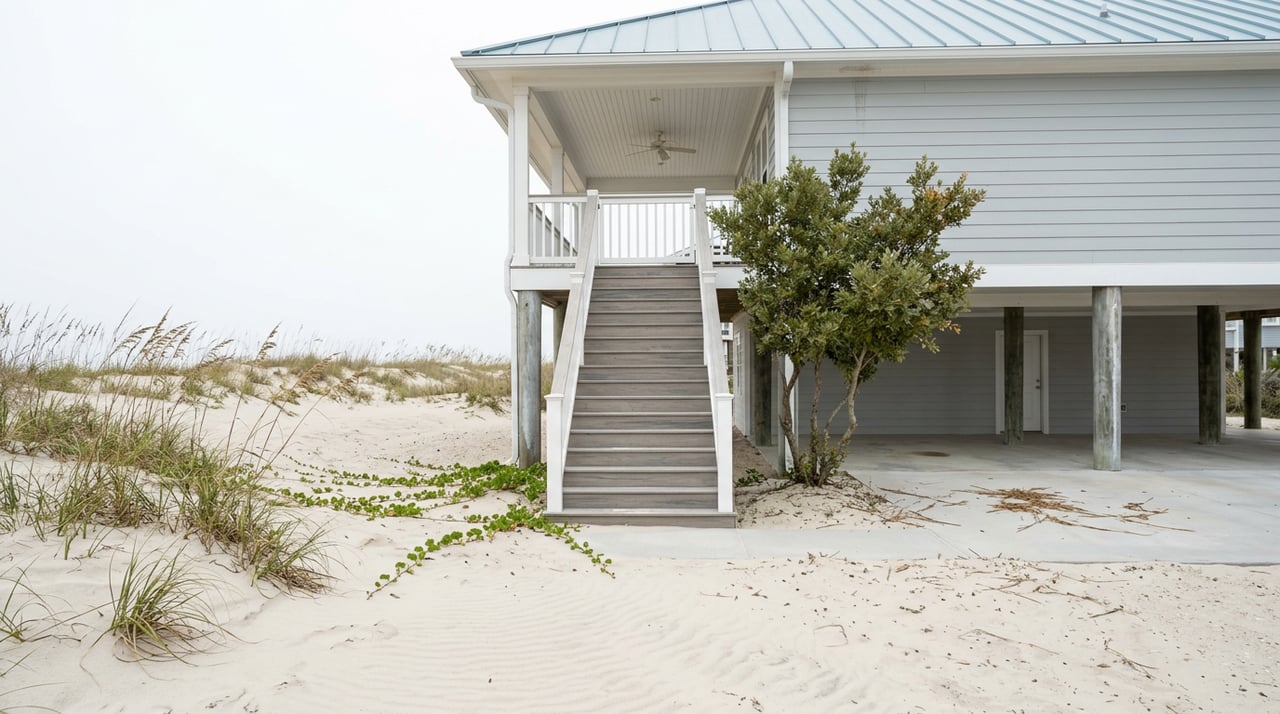
Walk the boardwalk near the Oak Island Lighthouse this month and you might notice something new staked into the sand: a length of rope, maybe a small sign, cordoning off a stretch of dune that looked exactly like the dune next to it yesterday. No storm passed through. No turtle nest sits inside the line. If you ask a neighbor what's going on, the honest answer is that the town is about to harvest its own beach.
Caswell Beach's dune system isn't just protected. It's actively farmed, and the operation runs on a set of numbers that explain why a 400-person town treats grass seed like a resource worth guarding.
The company doing the work is Coastal Transplants, a family-owned outfit based in Bolivia that has been growing dune vegetation since 1997. Every year, Coastal Transplants comes to Caswell Beach twice: once to fertilize the existing stand of sea oats, American beach grass, and bitter panicum along the dune line, and again, later in the season, to harvest seed from those same plants. According to the town's own Sea Oats FAQ, the transplanting and growing season for this vegetation runs from mid-April through late September, which puts the town squarely in its working window right now.
That second visit, the harvest, is why the rope line shows up. Coastal Transplants operations manager Worth Mercer walked the Board of Commissioners through the process in detail at a meeting reported by the State Port Pilot, explaining that the fertilization work that precedes each harvest sets up plants to produce a heavier seed crop before crews come back to collect it.
Mercer's presentation covered why the town relies on more than one species to hold its dunes together. Each does something the others can't:
Mercer described all three as pioneer species. Nothing else on the beach establishes without them going first.
Here's the number that turns this from a landscaping chore into a genuine local operation. According to the town's own FAQ, a sea oat seed that falls naturally from the plant and germinates on its own has roughly a 1 in 100,000 chance of becoming a new plant. Once that seed is harvested and replanted under managed conditions, the odds jump to about 1 in 10.
That gap is why Coastal Transplants doesn't just let the seed drop where it grows. Crews collect it, run it through a hammer mill to break up the seed spikelets, and move it into a germination chamber before anything gets replanted. The reporting from that same commissioners' meeting described a higher germination rate under this process than in the wild.
The payoff compounds from there. The town's FAQ notes that an average Caswell Beach lot needs roughly 2,000 established sea oats before a dune is considered stable, and that transplants grown from local Caswell seed and raised in a greenhouse survive at close to a 90 percent rate once replanted. Mercer told commissioners that over decades of this cycle, Caswell Beach's own seed line has effectively become its own local strain, better adapted to this stretch of sand than seed brought in from elsewhere. Asked why, his answer was refreshingly honest: nobody at Coastal Transplants has a scientific explanation. The local seed just performs better here, year after year.
That's the piece worth sitting with. This isn't a beautification program. It's a closed loop, the town growing its own genetic stock from its own dunes and putting it right back where it came from, because after enough seasons, homegrown outperforms imported.
Most of the dune along Caswell Beach Road sits on privately owned lots, which raises an obvious question: how does a contractor get permission to harvest from land that belongs to individual homeowners? The town's FAQ addresses this directly. North Carolina General Statute 14-129.2 makes it unlawful to take sea oats from someone else's land without consent. But the Coastal Area Management Act, the state law governing development along the shoreline, also restricts what a private owner can do inside a vegetated dune, including where they're allowed to place pilings for a beach crossover.
If a homeowner objects, the FAQ makes clear they can. Reporting from the same commissioners' meeting noted that the town notifies residents ahead of each harvest through NotifyMe email alerts and posts digital signage along the affected stretch, and that property owners retain the right to decline having their section of beachfront harvested.
Part of what makes this worth writing about is scale. Caswell Beach occupies the eastern tip of Oak Island, a quiet, mostly residential stretch with no commercial strip to speak of. According to Wikipedia's summary of the town, the Oak Island Golf Club is the only business located within Caswell Beach's town limits, and its clubhouse restaurant, Duffer's Pub & Grille, is where a lot of that dune-crew conversation probably continues over lunch. This is a town where a seed harvest gets a full presentation at a commissioners' meeting, not because the town lacks bigger issues, but because in a place this size, the dune really is the infrastructure. Lose it, and Caswell Beach Road, the only road running the length of town, goes with it.
The town's beach has needed rebuilding before. Renourishment tied to the Wilmington Harbor Channel project brought in sand more than once over the past two decades, and the town earned national recognition in 2002 for its restoration work. Coastal Transplants' more recent efforts, including a planting and fertilizing round documented by WECT in July 2026, are part of that same long-running program, not a one-time fix.
So the next time you see a rope line on the dune with no obvious storm damage or turtle nest to explain it, you'll know what's actually happening. A crew is collecting seed that outperforms anything shipped in from another beach, running it through a mill and a germination chamber, and getting ready to put it back exactly where it came from. It's a small, quiet piece of civic machinery that keeps the sand, and the road behind it, where it belongs.
If you're weighing what it means to live somewhere that treats its own dune line this seriously, or you're simply curious what else shapes daily life on this stretch of the coast, the team at Better Beach Sales knows Caswell Beach block by block. Schedule a Consultation and experience Oak Island the way people who actually live here do.
This article is general information, not legal, tax or financial advice. Consult a qualified professional about your situation.
Stay up to date on the latest real estate trends.
Imagine a place where work and play seamlessly blend into one fulfilling lifestyle. Our approach at Better Beach Sales goes beyond finding you the perfect home—it’s about building a community that thrives on collaboration and the natural beauty of Oak Island. Together, we can create opportunities, share success, and truly enjoy all that our coastal haven has to offer.